

For patients with SBP >140 mm Hg taking two or more antihypertensives,
BAXFENDY: The first and only FDA-APPROVED aldosterone synthase inhibitor[1a]
MOA
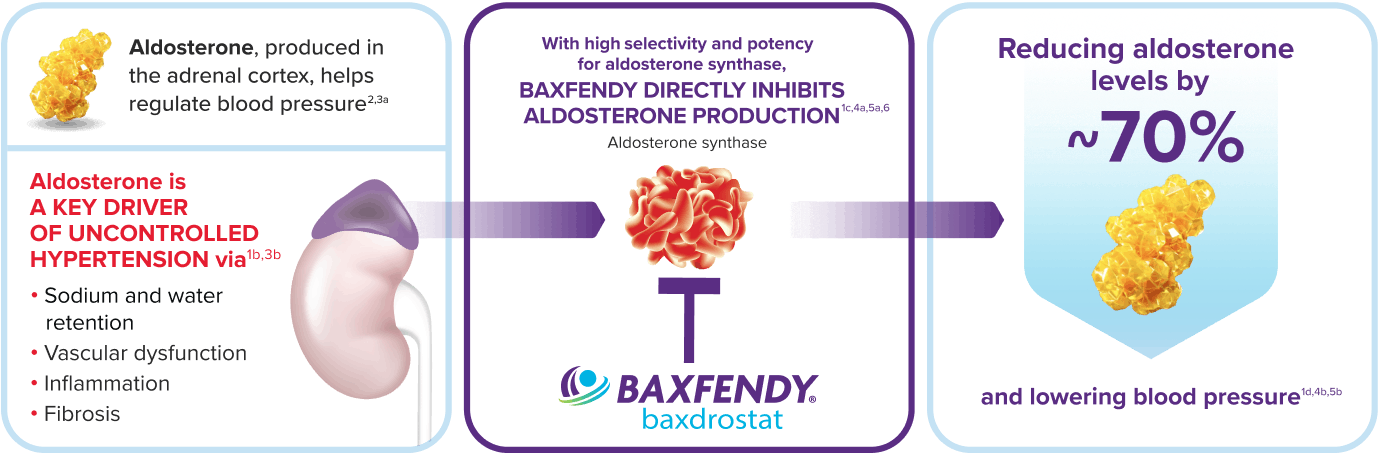

OVERVIEW OF ANTIHYPERTENSIVES AND THEIR EFFECTS ON ALDOSTERONE LEVELS
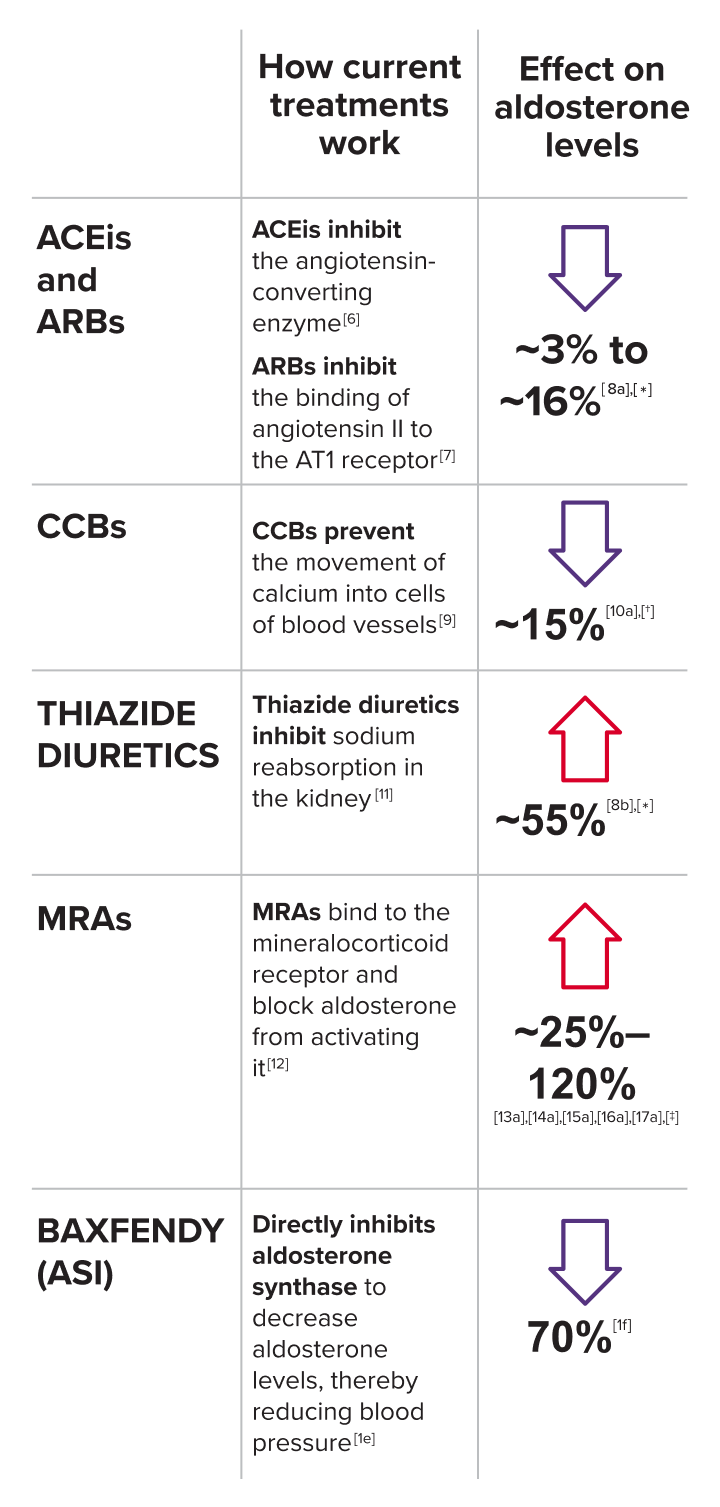
| ACEis and ARBs | CCBs | THIAZIDE DIURETICS | MRAs | BAXFENDY (ASI) | |
|---|---|---|---|---|---|
| How current treatments work | ACEis inhibit the angiotensin-converting enzyme[7] ARBs inhibit the binding of angiotensin II to the AT1 receptor[8] | CCBs prevent the movement of calcium into cells of blood vessels[10] | Thiazide diuretics inhibit sodium reabsorption in the kidney[12] | MRAs bind to the mineralocorticoid receptor and block aldosterone from activating it[13] | Directly inhibits aldosterone synthase to decrease aldosterone levels, thereby decreasing blood pressure[1e] |
| Effect on aldosterone levels |  ~70%[1f] ~70%[1f] |

It is unknown if pharmacologic differences correlate with efficacy or safety.
There are no head-to-head clinical trials comparing these therapeutic classes to BAXFENDY.[1g]
*^ Based on a randomized, open-label trial that assessed aldosterone escape in patients with mild-to-moderate hypertension (n=64) treated for 12 weeks with antihypertensives, including an ACEi, an ARB, a diuretic, or an ACEi+ARB combination. From Week 0 to Week 12, quinapril (20 mg/day) lowered plasma aldosterone by 15.8% (7.6–6.4) and irbesartan (150 mg/day) lowered aldosterone by 2.5% (8.0–7.8), while aldosterone levels increased by 54.9% with a hydrochlorothiazide diuretic (25 mg/day; 9.1–14.1).[9c]
†^ In a randomized study of patients with hypertension and suspected PA (n=230) that evaluated the effects of single antihypertensive therapies prescribed for >2 months on ARR, amlodipine (10 mg/day) reduced PAC by 14.72% (29.2–24.9).[11b]
‡^ In a study of healthy volunteers who received eplerenone (100 mg/day) for 10 days, a 120% increase in serum aldosterone AUC was observed.[15b] In a separate study that evaluated the effects of spironolactone (25 mg/day) on PAC in patients with resistant hypertension (n=39), PAC increased by 24.67% (15.4–19.2) after 6 months of therapy.[14b] Increases in aldosterone levels were observed within this range in other studies, including a retrospective study of patients with hypertension treated with MRAs (n=146; 62% of whom were diagnosed with PA), a separate randomized, controlled, dose-ranging trial in Japanese patients with essential hypertension (n=193), and another randomized study using the subset cohort of patients from the EPHESUS trial (n=453).[16b],[17b],[18b]
Consider a new approach at 3rd line for your patients with uncontrolled hypertension
Discover the dataAbbreviations: ACEi=angiotensin-converting enzyme inhibitor; ARB=angiotensin receptor blocker; ARR=aldosterone-renin ratio; ASI=aldosterone synthase inhibitor; AUC=area under the curve; CCB=calcium channel blocker; FDA=Food and Drug Administration; MRA=mineralocorticoid receptor antagonist; PA=primary aldosteronism; PAC=plasma aldosterone concentration; SBP=systolic blood pressure.
References:
- 1a 1b 1c 1d 1e 1f 1g BAXFENDY® (baxdrostat) [prescribing information]. Wilmington, DE: AstraZeneca Pharmaceuticals LP; 2026.
- ^ Papadopoulou-Marketou N, Vaidya A, Kaltsas G, et al. Hyperaldosteronism. In: Endotext [Internet]. South Dartmouth (MA): MDText.com, Inc. Updated February 16, 2026. Accessed April 5, 2026. https://www.ncbi.nlm.nih.gov/books/NBK279065
- 3a 3b Guzik TJ, Tomaszewski M. Aldosterone synthase inhibition for hypertension. N Engl J Med. 2025;393(14):1436-1439.
- 4a 4b Flack JM, Azizi M, Brown JM, et al; BaxHTN Investigators. Efficacy and safety of baxdrostat in uncontrolled and resistant hypertension [including online supplement]. N Engl J Med. 2025;393(14):1363-1374.
- 5a 5b Azizi M, Brown JM, Dwyer JP, et al; Bax24 investigators. Effect of baxdrostat on ambulatory blood pressure in patients with resistant hypertension (Bax24): a phase 3, randomised, double-blind, placebo-controlled trial [including online supplement]. Lancet. 2026;407(10532):988-999.
- ^ Bogman K, Schwab D, Delporte M-L, et al. Preclinical and early clinical profile of a highly selective and potent oral inhibitor of aldosterone synthase (CYP11B2). Hypertension. 2017;69(1):189- 196.
- ^ Singh B, Cusick AS, Goyal A, et al. ACE inhibitors. In: StatPearls [Internet]. Treasure Island (FL): StatPearls Publishing. Updated May 4, 2025. Accessed April 5, 2026. https://pubmed.ncbi.nlm.nih.gov/28613646/
- ^ Patel P, Launico MV. Angiotensin II receptor blockers (ARB). In: StatPearls [Internet]. Treasure Island (FL): StatPearls Publishing. Updated May 5, 2025. Accessed April 5, 2026. https://pubmed.ncbi.nlm.nih.gov/30725712/
- 9a 9b 9c Ubaid-Girioli S, Ferreira-Melo SE, Souza LA, et al. Aldosterone escape with diuretic or angiotensin-converting enzyme inhibitor/angiotensin II receptor blocker combination therapy in patients with mild to moderate hypertension. J Clin Hypertens (Greenwich). 2007;9(10):770-774.
- ^ McKeever RG, Patel P, Hamilton RJ. Calcium channel blockers. In: StatPearls [Internet]. Treasure Island (FL): StatPearls Publishing. Updated February 22, 2024. Accessed April 5, 2026. https://pubmed.ncbi.nlm.nih.gov/29494080/
- 11a 11b Mulatero P, Rabbia F, Milan A, et al. Drug effects on aldosterone/plasma renin activity ratio in primary aldosteronism. Hypertension. 2002;40(6):897-902.
- ^ Patel P, Preuss CV. Thiazide diuretics. In: StatPearls [Internet]. Treasure Island (FL): StatPearls Publishing. Updated July 6, 2025. Accessed April 5, 2026. https://www.ncbi.nlm.nih.gov/books/NBK532918/
- ^ Patibandla S, Heaton J, Kyaw H. Spironolactone. In: StatPearls [Internet]. Treasure Island (FL): StatPearls Publishing. Updated July 4, 2023. Accessed April 5, 2026. https://www.ncbi.nlm.nih.gov/books/NBK554421/
- 14a 14b Ubaid-Girioli S, de Souza LA, Yugar-Toledo JC, et al. Aldosterone excess or escape: treating resistant hypertension. J Clin Hypertens (Greenwich). 2009;11(5):245-252.
- 15a 15b Eudy RJ, Sahasrabudhe V, Sweeney K, et al. The use of plasma aldosterone and urinary sodium to potassium ratio as translatable quantitative biomarkers of mineralocorticoid receptor antagonism. J Transl Med. 2011;9:180.
- 16a 16b Kobayashi M, Pitt B, Ferreira JP, et al. Interaction between aldosterone and mineralocorticoid receptor antagonist: findings from the EPHESUS trial. JACC Heart Fail. 2025;13(8):102479.
- 17a 17b Saruta T, Kageyama S, Ogihara T, et al. Efficacy and safety of the selective aldosterone blocker eplerenone in Japanese patients with hypertension: a randomized, double-blind, placebo-controlled, dose-ranging study. J Clin Hypertens (Greenwich). 2004;6(4):175-185.
- 18a 18b Tezuka Y, Turcu AF. Mineralocorticoid receptor antagonists decrease the rates of positive screening for primary aldosteronism. Endocr Pract. 2020;26(12):1416-1424.


